


The town of Musa Qala is a dangerous place.
Surrounded by mountains, at an altitude of 3,400ft above sea level, in the north of Afghanistan's Helmand province, it was, until recently, controlled by the Taliban.
British and American troops, backed by members of the fledgling Nato-trained Afghan National Army, took the strategic town in December, after some of the fiercest fighting in the country since the Taliban regime was toppled in 2001.
Entrenched in a string of fortified encampments - called Forward Operating Bases, and manning strategic hilltop Observation Posts, the men of Oxfordshire's Territorial Infantry battalion, 7 Rifles, are doing their bit to bring stability to this lawless region all the way up the Helmand River to the flashpoints of Sangin and Kajaki.
This is the centre of the Afghan opium trade - with swathes of green poppy fields standing out among the parched biscuit-coloured desert.
The soldiers tell stories of long camel caravans making their way through the desert, carrying raw opium and refined heroin to the Pakistani and Iranian frontiers, from where it is trafficked to the West.
When the British captured Musa Qala, they discovered a heroin refinery in a row of derelict garages - and a stock of opium which would have produced heroin with a street value of £5m. It was burned on a bonfire.
British soldiers are now sheltering in the open-fronted buildings, which offer little protection against the rain, snow and intense cold - night-time temperatures often fall to -10C.
Up to seven heroin refineries in the district have been destroyed by the allies - depriving the Taliban of vital funds, collected through tithes from farmers and protection money paid by smugglers.
But while Musa Qala's battered, bullet-holed district centre may have been retaken, the Taliban are still out there in the hills and villages, murdering anyone suspected of collaborating with the British or Afghan government forces, ambushing convoys, firing rockets and mortars, and planting roadside bombs - so-called Improvised Explosive Devices.
There is also the ever-present danger of landmines, planted by the Russians during their occupation of the country in the 1980s, which have killed British soldiers - including Corporal Darryl Gardiner, a member of the Royal Electrical and Mechanical Engineers, attached to the Royal Artillery, last month.
His death shocked the Rifles. A number of the Oxfordshire soldiers knew him, and others injured in the explosion, just outside the town.
A more sinister threat comes from suicide bombers, one of whom targeted troops in the town last month - blowing himself up after being shot by a soldier on guard duty.
This is the day-to-day reality faced by the troops of 7 Rifles, part of the Rifles regiment's Salonika Company.
For many, the reality of war is hard to comprehend.
"In one place, we were attacked twice with small arms," said Rifleman Dan Hobley, 22, from Witney, now back in the British base at Camp Bastion, near the regional capital Lashkar Gah.
"It was funny it felt like a computer game. If you're a regular soldier, and do this for a living, it would seem normal, but not for us in the TA."
Using Bastion as a staging post, our troops and their Afghan allies are taken to their positions in the volatile north of the province by Chinook helicopter, the RAF's workhorses.
They are accompanied by heavily-armed Apache attack helicopters and fire flares before landing, as protection against the threat of incoming heat-seeking missiles.
Gunners sit at the stern scanning the ground for attackers, while passengers wear body armour and helmets in case of small arms fire. The risk is ever-present.
"We are not here to impose standards or control the ground," says Major Ian Postgate, Salonika Company's commander. "We are here to support the Afghan government."
Praising Oxfordshire's TA soldiers, he added: "They are giving up a year of their life. It's a big commitment to make to what is, effectively, a second job.
"It's not easy to evaluate our contribution and it might take some years until we can say 'that's why we are here'.
"We are building for the long term."
Rifleman Carl Alford, from Northway, Oxford, is guarding the Rowshan Tower - a mobile phone mast on a hilltop, overlooking the town.
He's been there for more than a month, and admits it's a lonely job.
"I'm just stuck up here on 'the hill', as we like to call it.
"We've seen a little bit of action, but not much towards us. It can be boring doing the same monotonous job every day. I was in Iraq before this, and it was hard leaving home for a second time. But I'm having a great time in the mud."
Rifleman Jason Purcell, 30, has been in the TA for more than six years and is relishing life at the front - based at an observation post overlooking a strategic road linking Musa Qala with a key British base, FOB Edinburgh.
"Life out here is great," he says. "I'm loving it. The only problem is communication. I've been here so long and it does get lonely.
"It's just hills and little villages and wadis - and this little road. It's just a track to us but to the locals it's a motorway. It's a smuggling route, and our job is to stop people in vehicles acting suspiciously.
"We are here 24 hours a day, seven days a week, making sure no-one plants any explosive devices."
At the moment things are quiet, with a drop in the number of attacks and ambushes.
But the soldiers are under no illusions about the task ahead.
"It's only quieter because it's winter," says Corporal Sean Lentell, whose family live in Finstock, near Charlbury.
"During the winter the head honchos of the Taliban have a break. But when the weather warms up, they'll come back."
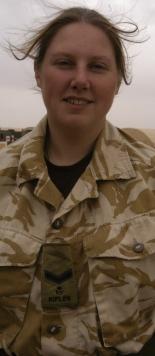
- Among the Rifles soldiers in Afghanistan is medic Lance Corporal Leonie Barnard, 26, from Headington, Oxford.
She said: "The whole experience has been amazing. I have gained so much experience.
"I have just finished a degree in cell and molecular biology at Oxford Brookes University.
"My friends thought I was mad for being in the Army, giving up my weekends and Tuesday evenings to go to TA, instead of going to the pub.
"But life in the TA is completely different. It's so much more interesting and exciting than life back home and it's going to be hard going back to normality. I'm not an adrenaline junkie though.
"It isn't what I expected. I thought we would be mortared every minute.
"I don't have to justify the war. I'm here to save lives.
"My day-to-day life is primary health care and that's like a normal job: I go to work, break for lunch, and in the evening drink lots of tea - and gossip."
"The things I miss most are going to the pub and socialising."


Comments: Our rules
We want our comments to be a lively and valuable part of our community - a place where readers can debate and engage with the most important local issues. The ability to comment on our stories is a privilege, not a right, however, and that privilege may be withdrawn if it is abused or misused.
Please report any comments that break our rules.
Read the rules hereComments are closed on this article